







Start Japanese with Kana, Not Romaji
Two small alphabets of sound unlock every Japanese sentence. Why hiragana then katakana beats romaji, how the kana grid works, and how to make the shapes stick.
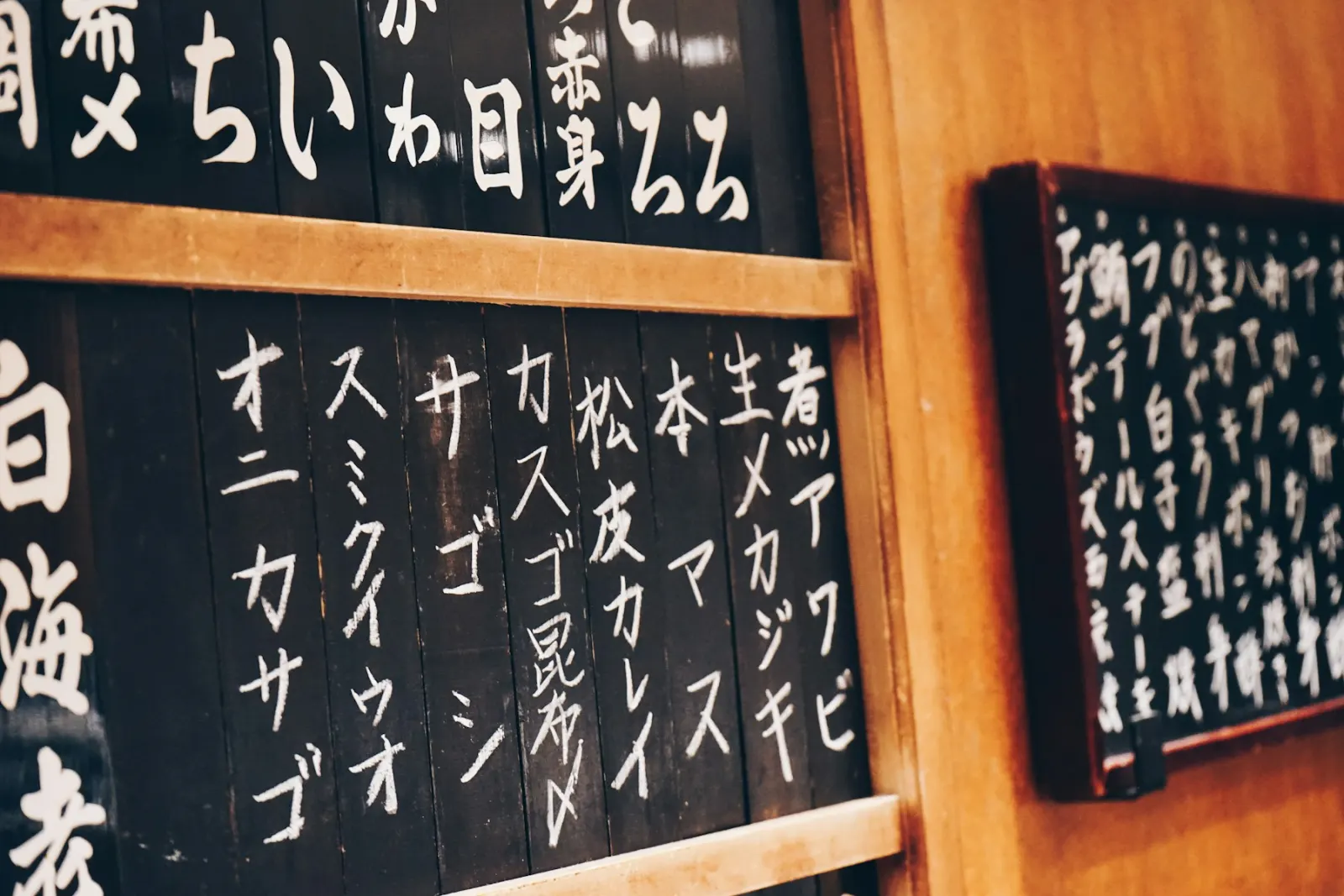
Before words, before grammar, Japanese asks you to learn two small alphabets of sound. Hiragana first, then katakana, and no romaji crutch in between: it is the shortest route to reading real Japanese.
Every Japanese learner meets the same fork on day one. You can keep reading Japanese in Roman letters, konnichiwa and arigatou, or you can spend a couple of weeks learning the native sound scripts. The second path feels slower for about ten days. After that it is faster in every way.
Why romaji holds you back
Romaji looks friendly, but familiar letters invite English spelling habits. Learners read ue (うえ, above) as "you", stretch or shorten vowels at random, and never notice that Japanese has a rhythm English lacks.
That rhythm is built on the mora, a beat of roughly equal length. Each kana is one beat, and small details change meaning. おばさん (obasan, aunt) has four beats; おばあさん (obāsan, grandmother) has five. きて (kite, come) has two; きって (kitte, postage stamp) has three, because the small っ is a silent beat of its own. Romaji often blurs these differences; kana cannot, because the extra beat is right there on the page.
There is a practical reason too. No Japanese sign, menu, manga or website is written in romaji. Every hour you spend with it is an hour spent reading a script you will have to abandon.
How the kana system works
Hiragana and katakana are two versions of the same set of sounds. Hiragana handles native words and grammar endings; katakana is used mostly for words borrowed from other languages, names, and emphasis. Learn the logic once and you have learned it twice.
The gojūon grid
The kana are laid out in a grid called the gojūon (五十音, "fifty sounds"). The five vowels あいうえお (a i u e o) form the first row. Every other row is a consonant combined with those same five vowels: かきくけこ (ka ki ku ke ko), さしすせそ (sa shi su se so), and so on through t, n, h, m, y, r and w, plus the single consonant ん (n). A handful of cells are irregular to an English ear, such as し (shi), ち (chi), つ (tsu) and ふ (fu), but the grid itself is completely regular. Once you know a row's consonant and the vowel order, you know where every sound lives.
Two little marks that double the chart
A pair of short strokes called dakuten (゛) voices a consonant: か (ka) becomes が (ga), さ (sa) becomes ざ (za), た (ta) becomes だ (da), は (ha) becomes ば (ba). A small circle, the handakuten (゜), turns the h-row into p: は becomes ぱ (pa). You learn one rule, not new characters.
Small ya, yu, yo
Write a small ゃ, ゅ or ょ after a kana from the i-column and the two merge into one beat: き + ゃ gives きゃ (kya), し + ょ gives しょ (sho), ち + ゅ gives ちゅ (chu). Compare びょういん (byōin, hospital) with びよういん (biyōin, beauty salon). The size of one character decides whether you are asking for a doctor or a haircut.
Long vowels and the small tsu
In hiragana, a vowel is lengthened by adding another vowel: おかあさん (okāsan, mother), おにいさん (onīsan, older brother). Two combinations are worth knowing early: えい is usually said as a long e, as in せんせい (sensei, teacher), and おう as a long o, as in がっこう (gakkō, school). Katakana is simpler: a dash, ー, stretches any vowel, as in コーヒー (kōhī, coffee) and ケーキ (kēki, cake).
The small っ, as in きって, doubles the following consonant. In practice it feels like a tiny held breath before the next sound. Clap the beats as you say it and you will feel why it counts.
Why hiragana comes first
Hiragana carries the grammar of every sentence. Particles like は, を and に, verb endings like 〜ます and 〜ました, and furigana, the small reading aids printed above kanji, are all hiragana. With hiragana alone you can read children's books, the endings of every sentence, and the pronunciation of any kanji a text chooses to annotate.
Katakana comes second because it is the same system with new shapes, and because the words it spells are often ones you half-know already: テレビ (television), パン (bread), バス (bus). Katakana also adds a few combinations for sounds that Japanese borrowed along with the words, such as ファ (fa) and ティ (ti), and it has some famous look-alikes. シ (shi) and ツ (tsu) differ mainly in the angle of their strokes; so do ソ (so) and ン (n). It is much easier to sort those out once hiragana feels automatic.
Making the shapes stick
A few techniques make the shapes manageable.
- Attach a picture to each shape. A simple, slightly absurd story links a shape to its sound. Make your own when a ready-made one does not click; the act of inventing it is part of the memory.
- Write by hand, in the right order. Tracing with correct stroke order gives the shape a second route into memory and makes handwritten kana far easier to read later.
- Test yourself instead of rereading. Retrieval practice, the finding popularised by Roediger and Karpicke's 2006 studies, shows that pulling an answer out of memory strengthens it more than looking at it again. Covering the romaji and guessing is worth more than another pass through the chart.
- Space it out. Fifteen minutes on five days beats an hour and a quarter on one. The spacing effect is one of the most reliable results in learning research.
- Read real words early. A kana you have read inside さかな (fish) or ともだち (friend) is anchored to something meaningful, not floating on a chart.
Kana is the one part of Japanese you can genuinely finish. A few weeks of steady practice, and it is done for good.
How Japanese Phonetics teaches it
Japanese Phonetics is the "start here" app of the BitSize Japanese track. It follows exactly the order above: hiragana first, row by row, then the marks, the small ya-yu-yo combinations, the small tsu and long vowels, then real-word reading. Katakana follows the same path and adds the long-vowel dash, the foreign-sound combinations and the look-alike pairs.
Each lesson moves through four steps on one page:
- Learn. A card for each kana with a memory hook, an animated stroke order and a few simple words that use it, each with audio.
- Write. You trace each character stroke by stroke.
- Drill. A mixed set of questions: hear a sound and pick the kana, read a kana and pick its sound, recognise it inside a word, catch it in a spoken word.
- Results. Your first-try answers are scored. Reach 80% and the lesson counts as passed and the next one opens, permanently.
Around the lessons are three practice tools that are never scored. The interactive chart lets you tap any kana to hear it and watch its strokes. The draw page lets you trace any character freely. The speed test gives you twenty quick questions from the basic set, the voiced set, the combinations, or all of them, which is a good way to find the few characters that still slow you down.
Each sound has one audio clip shared by both scripts, so か and カ sound identical, as they should. After you pass lessons, their kana come back in the Japanese track's daily ten-question review, mixed in with whatever else you are studying, so the early rows do not fade while you work on later ones.
Your first week
Try this: learn one row of hiragana a day, a, ka, sa, ta, na and so on. Write each new kana five times while saying it aloud, then spend two minutes testing yourself on every row learned so far. On day seven, read ten short words written only in hiragana without looking anything up.
If you use the app, the first lesson is free without an account and the next two are free once you sign up. Do one lesson a day, use the chart when a character feels shaky, and run the speed test at the week's end. By the time hiragana is automatic, katakana will feel like a familiar tune in a new key.