




















Five Kanji a Day: A Walkable Path Through All 2,136
Kanji are building blocks, not random pictures. How components, on and kun readings and stroke order work, and why five a day reaches every Jōyō kanji.
Kanji look like thousands of unrelated pictures. They are really a small set of building blocks, a few reading rules and a steady routine. Five a day is enough to reach every one of the 2,136 Jōyō kanji.
The Jōyō list is the official set of 2,136 kanji taught in Japanese schools and used in newspapers, signs and everyday writing. Faced with that number, many learners either give up or try to cram. Both miss how kanji are actually built. Once you see the structure, the list stops being a wall and becomes a long, walkable path.
Kanji are made of parts
Most kanji are combinations of smaller, recurring components. Learn the components and each new kanji becomes a new arrangement of familiar pieces instead of a fresh picture to memorise.
Take 休 (rest). On the left is 亻, a compressed form of 人 (person); on the right is 木 (tree). A person leaning against a tree is resting. Or 明 (bright): 日 (sun) beside 月 (moon), the two brightest things in the sky.
Components often signal a family of meaning. The radical 言, speech, sits on the left of 話 (talk), 読 (read) and 語 (language, word). The three-drop radical 氵, water, marks 海 (sea), 池 (pond) and 泳 (swim). When you meet an unknown kanji with 氵 on the left, you can make a reasonable guess that it has something to do with water.
Other components hint at sound. 晴 (clear weather), 清 (pure), 精 (spirit, precision) and 静 (quiet) all contain 青, and all four have the reading セイ (sei). The hint is not a guarantee, but it turns guessing into educated guessing.
On and kun: why one kanji has several readings
Kanji came to Japan from China, and Japanese kept two kinds of reading side by side.
- The on-reading (音読み) descends from the Chinese pronunciation. Dictionaries usually print it in katakana.
- The kun-reading (訓読み) is the native Japanese word attached to the character. It is usually printed in hiragana.
山 (mountain) is read やま (yama) on its own, its kun-reading, but サン (san) in 富士山 (ふじさん, Mount Fuji), its on-reading. 水 (water) is みず (mizu) on its own and スイ (sui) in 水曜日 (すいようび, Wednesday).
Some kanji have many readings. 生 (life, birth, raw) appears in 先生 (せんせい, teacher), 一生 (いっしょう, a lifetime), 生まれる (うまれる, to be born), 生きる (いきる, to live) and 生 (なま, raw). That looks alarming until you notice a rule of thumb that holds most of the time: kanji in compounds tend to take on-readings; a kanji followed by hiragana endings tends to take its kun-reading. 先生 is a compound, so セイ. 生きる has the ending きる, so い.
There are exceptions, some of them very common. 今日 (today) is きょう, a reading that belongs to the whole word rather than to either kanji. Exceptions like this are the strongest argument for the next point.
Learn kanji through words
A kanji on its own rarely tells you how to say it. A word almost always does. If you learn 生 as a list of five readings, you have five facts with nothing to hang them on. If you learn it as 先生, 生まれる and 生, you have three useful words, and the readings come along for free.
Words also give you a meaning you can use tomorrow. Nobody needs to say "life" as a single kanji in conversation, but everybody needs "teacher". And a word inside a short sentence adds one more layer of context: a sentence you have heard and read is much harder to forget than a keyword on a flashcard.
Stroke order is logic, not etiquette
Stroke order can feel like fussy tradition. In fact it follows a few consistent principles that make writing faster and shapes easier to recognise:
- Top before bottom, left before right.
- A horizontal stroke usually comes before a vertical one that crosses it, as in 十.
- In small symmetrical kanji, the centre often comes first, then the sides, as in 小 and 水.
- Enclosures are drawn outside first, then the inside, and the bottom line closes the box last, as in 国.
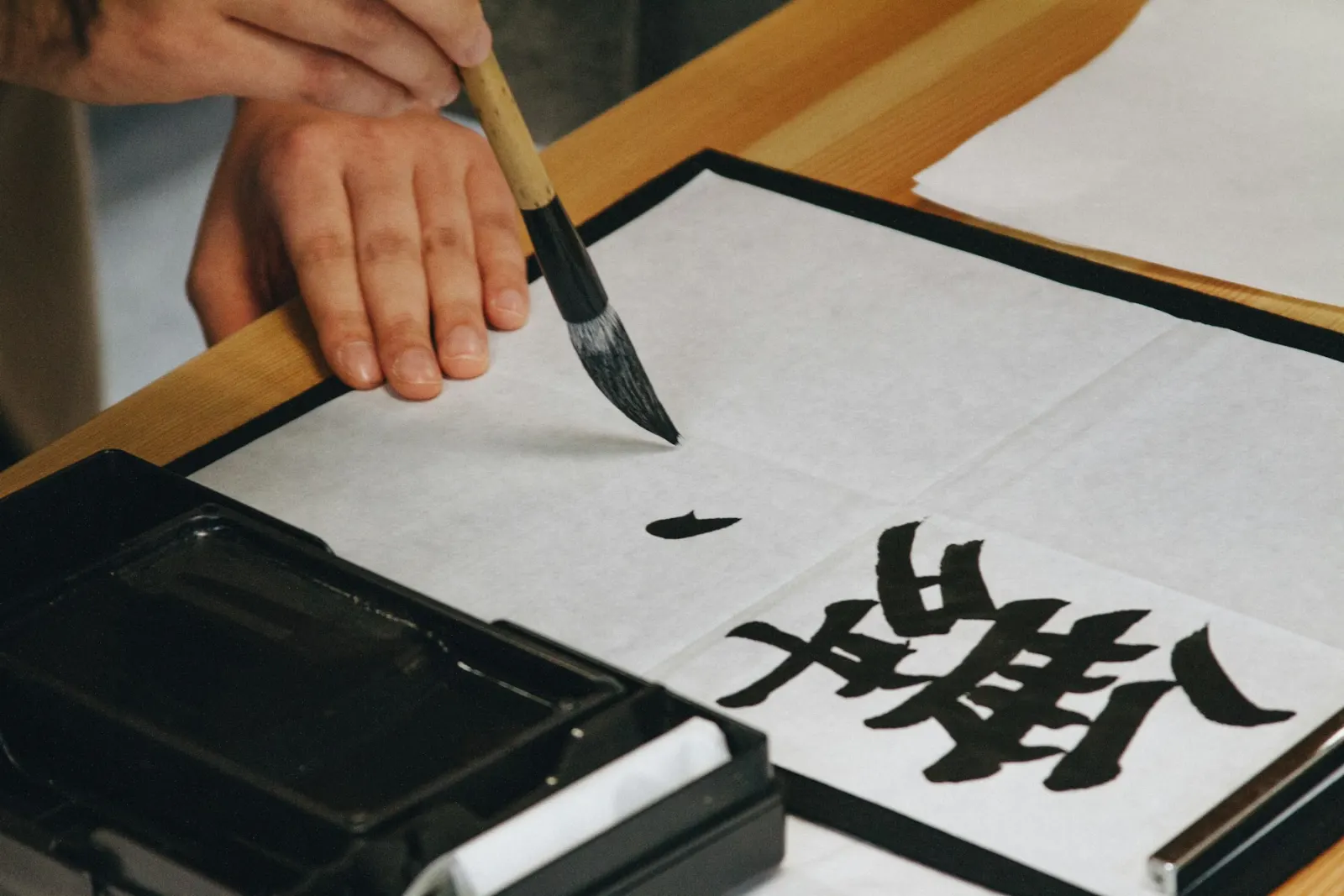
A few characters break the pattern in instructive ways. 右 (right) starts with the sweeping ノ stroke; 左 (left) starts with the horizontal line. Learning the correct order once saves you from relearning it later, and it makes handwritten and brush-style kanji far easier to read.
You do not memorise 2,136 pictures. You learn a few hundred parts and watch them recombine.
Pacing: why five a day works
Five kanji a day sounds modest. At that rate the full Jōyō list takes a little over a year of daily study. That is slow enough to review and fast enough to see steady progress, and it respects two well-established findings about memory.
The first is the forgetting curve, described by Hermann Ebbinghaus in the 1880s: new material fades quickly unless it is revisited. The second is the spacing effect: reviews spread out over days and weeks produce much stronger long-term memory than the same amount of study packed into one sitting. Cepeda and colleagues' 2006 review of distributed practice pulled together hundreds of experiments pointing the same way.
Cramming thirty kanji on a Sunday feels productive and mostly evaporates. Five a day, plus regular review of the ones you have already met, compounds.
Watch, trace, drill: how the Kanji app does it
BitSize Japanese Kanji covers all 2,136 Jōyō kanji, five per lesson, grouped by JLPT band from N5 up to N1. Each lesson is one page with four steps.
Learn
Each kanji gets a card with an animated stroke order and a stroke-by-stroke strip, a keyword, its kun and on readings, an original memory story, a warning when it has a look-alike, three key words and an example sentence with furigana and audio. Word audio is voiced from the kana reading; the sentence is voiced as a whole, so you hear the kanji in context.
Write
You trace each kanji. Strokes in the wrong order or direction are not accepted, and a hint appears after two misses. When you are ready, hard mode hides the outline so you have to recall the shape.
Drill
A quick set of generated questions tests the five kanji from different angles: meaning, recognition, the reading of a key word, a word you hear, and a gap in a sentence. Anything you miss comes back a few questions later until you get it right.
Results
Your first-try answers are scored. At 80% the lesson is passed and the next one opens for good; below that, you see what you missed and can try again. Afterwards, the kanji return in the Japanese daily review, ten mixed questions a day, spaced out so that the ones you know well come back less often and the shaky ones sooner. Each lesson shows a mastery stage, from Learning to Mastered, based on answers spread over days, not on how many times you repeated it in one sitting.
If you already know the early kanji, you do not have to start at the beginning: a short placement check lets you test out of a level.
This week
Try this: pick five kanji that share a component, such as 話, 読, 語, 記 and 計, all with 言 on the left. For each one, learn one common word, write it three times in the correct stroke order, and say the word aloud. Tomorrow, before learning anything new, write all five from memory.
If you use the app, do one lesson a day and then the daily review. Treat the Write step seriously even though it is not scored; it is where the shapes settle in. Five kanji today is a small thing. Five kanji every day for a year is every kanji a Japanese newspaper expects you to know.