




















Listening and Reading Your Way to B2
What carries you from beginner to B2 is steady input you can mostly understand. How to climb the DELF levels by ear and by eye: linked speech, numbers and prices, gist-then-detail reading.

Grammar gets you started, but what carries you from beginner to a confident B2 is input: a steady diet of French you can mostly understand, heard and read every day. Here is how to climb the DELF levels through listening and reading, and what to do at each stage.
What the levels actually ask of you
The DELF exams follow the Common European Framework of Reference, which describes ability in six levels from A1 to C2. For listening and reading, the climb looks roughly like this.
- A1: you catch familiar words and very simple phrases about yourself and your immediate surroundings, spoken slowly and clearly.
- A2: you follow short, clear messages and everyday exchanges: announcements, shop conversations, simple directions, prices and times.
- B1: you understand the main points of clear speech and text on familiar topics such as work, travel and leisure.
- B2: you follow extended speech and longer texts, including arguments, as long as the topic is reasonably familiar. You can tell what a speaker thinks, not just what they say.
That last point is the real jump. A1 and A2 are about catching information. B1 and B2 are about following reasoning: a concession, a reservation, a "yes, but".
Why input does the heavy lifting
Stephen Krashen's idea of comprehensible input, and Paul Nation's long body of work on graded and extensive reading, point in the same direction: we acquire a language largely by understanding messages in it. The key word is understanding. Material that is far too hard teaches very little, because you spend your effort decoding rather than absorbing. Material you can mostly follow, with a few new words and structures, is where growth happens, because the context does the teaching.
That is why levelled material matters. It keeps you in the zone where you understand enough to learn from what you do not.
Listening: getting used to real French
Words run together
Spoken French links words so tightly that learners often cannot find the boundaries. Les enfants ont appris comes out as one continuous stream, with a [z] linking les to enfants and a [t] linking ont to appris. This is not a matter of speed; even slow French is linked. The fix is exposure, plus the habit of replaying a phrase you missed and reading it after you have tried to hear it.
Numbers, prices and times
Numbers are where listening tests like to set traps, and where real life is least forgiving. French counting above sixty is built from sums and multiples: soixante-dix (70, literally sixty-ten), quatre-vingts (80, four twenties), quatre-vingt-dix-sept (97). Some pairs sound deceptively close, such as quatorze (14) and quarante (40), or seize (16) and six.
Prices are usually spoken as euros and then cents without the second unit: 12,50 € is douze euros cinquante. Note the decimal comma. Times often use the twenty-four-hour clock: dix-huit heures trente is 6.30 in the evening. A listening question will often mention several numbers and ask for the one that ends up being true, so train yourself to listen past the first figure you hear.
Listen for the turn
From B1 upwards, speakers often say one thing and then qualify it. Words like mais, pourtant, en revanche, certes and finalement signal that the important part is coming. At B2, the correct answer to "what does she think?" is often the point after the mais, not before it.
A1 and A2 are about catching information. B1 and B2 are about following reasoning.
Reading: gist first, detail second
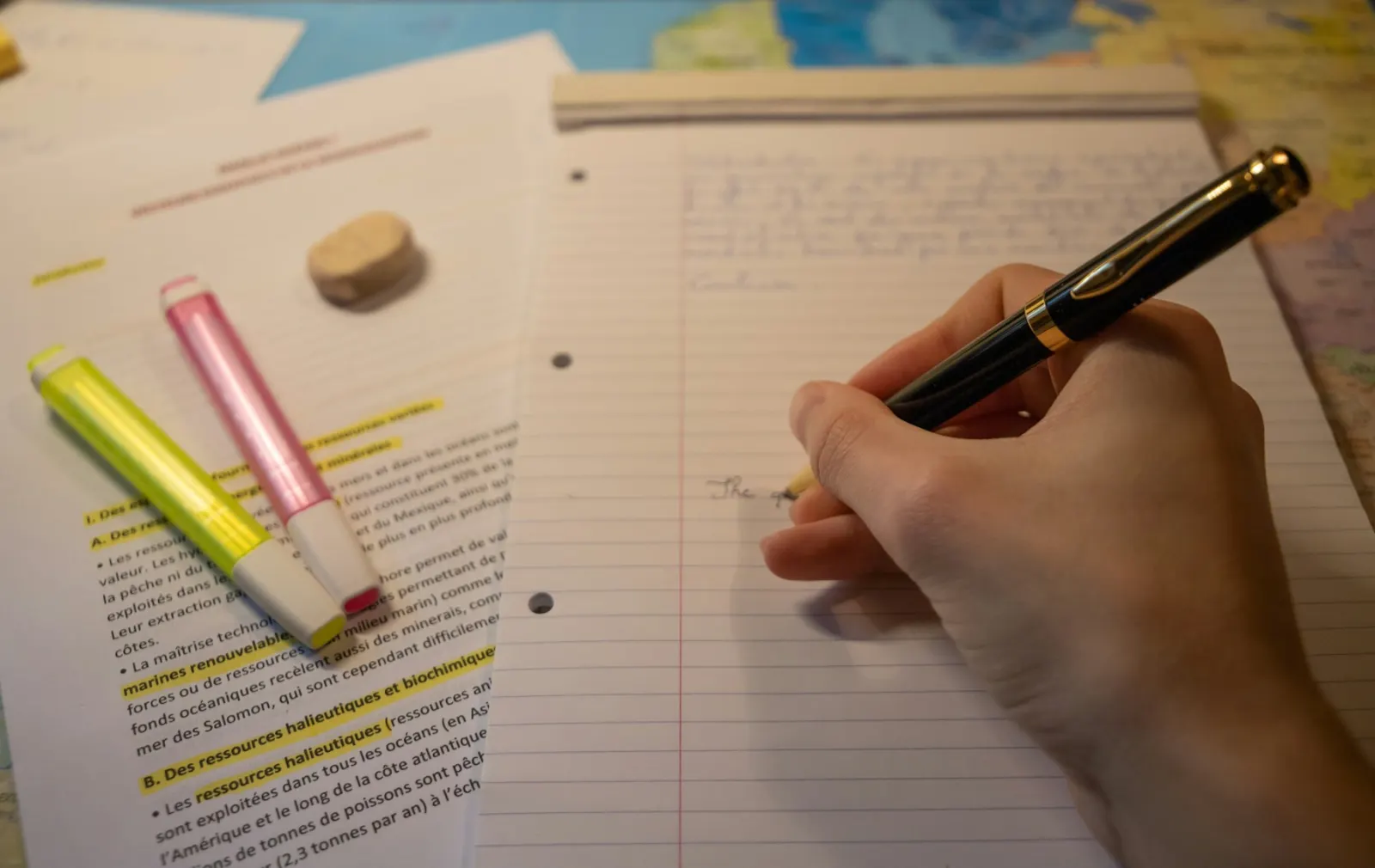
Good readers in any language read the same text in different ways for different purposes. Two passes work well for learners:
- Read for gist. Go through the whole text once without stopping. Do not look anything up. Afterwards, sum up in one sentence what it was about and what the writer's view seemed to be.
- Read for detail. Go through again, sentence by sentence. Now look up what blocks you, notice useful phrases, and check how the connectors (donc, pourtant, c'est pourquoi, alors que) steer the argument.
The first pass trains the tolerance for uncertainty that real reading requires. The second turns the text into a lesson. Skipping the first pass makes you a slow, dictionary-bound reader; skipping the second means the text slides past without leaving much behind.
Why reading across topics matters
Vocabulary clusters by subject. You can read comfortably about travel and still be lost in a short piece on psychology or economics, even at the same level of grammar. Reading across a range of topics, at each level, spreads your vocabulary evenly instead of building a deep knowledge of one narrow area.
How French Listening and French Reading put this into practice
BitSize's French Listening app runs from A1 up to B2. Each session is a short DELF-style listening test: a single clip, a dialogue or a piece of narration such as an announcement, an interview or a radio debate, and one question with four options, graded on the spot. The early levels lean on everyday situations, with prices, times and changing plans; B2 sessions move to longer interviews and debates where the question asks about a speaker's nuanced position.
After the test comes Deep Learn, in four tabs. Breakdown takes apart the dialogue's vocabulary, phrases and grammar, with audio. Speak lets you shadow the lines, with speech-recognition scoring and a record-and-compare option in supported browsers. Quiz checks the key language by ear (which phrase did you hear, is this translation right?) and ends with a fill-in-the-blank English summary where you choose the French phrases that fit. Summary gathers everything onto a single cheat sheet.
French Reading is organised into six categories: Life and Travel, Philosophy, Science, Psychology, Society and Culture. Each category is its own path of articles that climbs from A1 through A2 and B1 to B2, so you can read about the subjects that interest you while the difficulty rises gradually. Every article is a short, connected piece with audio for each sentence and a "play all" option, an English toggle you can turn on when you need it, notes on useful phrases, vocabulary and grammar, and a quiz in French at the end. You can read in a list view or focus on one sentence at a time, which maps neatly onto gist-then-detail reading.
Across both apps, passing a lesson's check unlocks the next one permanently, and the French track's daily ten-question review brings back language you met earlier, spaced out so it returns just as it starts to fade.
Try this: listen to any short French clip twice. The first time, write down every number you hear. The second time, write down what each number referred to. You will often find that the first figure you caught was not the one that mattered.
This week
Do one short listening and one short reading a day, at a level where you understand most of it. For each, do a gist pass and a detail pass. Practise numbers above sixty out loud until quatre-vingt-dix-sept comes without a pause. The first session of French Listening and the first article in every French Reading category are free without an account, and the next two are free once you sign up.